


Coo the music, pigeons set city's tone
Beijing breeders keep tradition of whistling wings, ornamental and racing birds alive











In his 1934 essay Autumn in Peiping, writer Yu Dafu described sitting in a courtyard on an autumn morning, looking up at the blue sky and hearing "the sound of domesticated pigeons flying overhead" — part of the unhurried, peaceful rhythm of everyday life in Beijing.
Nearly a century later, pigeons are still a defining characteristic of some areas of the city's skyline.
On Sept 21, Chinese and foreign guests released white pigeons at a gathering to mark the International Day of Peace. The birds, rising together above the crowd, were a familiar symbol of peace.
Similar scenes have unfolded at Tian'anmen Square during National Day celebrations and other major commemorations, when thousands — sometimes tens of thousands — of pigeons have been released above the heart of Beijing.
But behind the feathered pageantry is a community with lifelong passion for pigeons and associated traditions.
Some of the pigeons released on Sept 21 were raised and trained by Li Xiaolong, a veteran pigeon-keeper from Xicheng district. Li has been around pigeons since he was 3 years old. "I'd hold a pigeon in my hands and play with it," he said. "I was at the pigeon loft almost every day."
His love of the birds drew another Beijing boy into the world of pigeons.
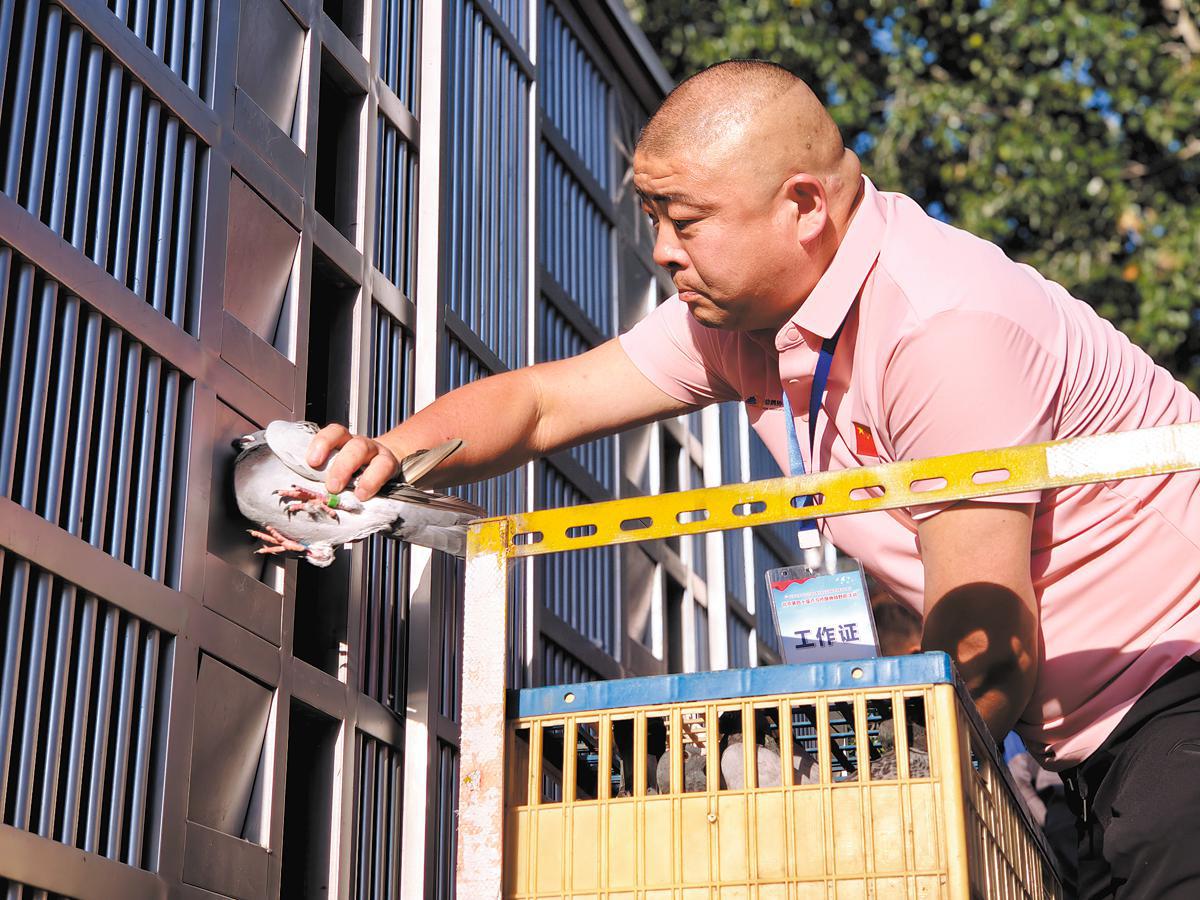
Ma Chunyu was not yet in kindergarten when he got his first pair of pigeons, taken from beneath the eaves of a neighbor's house. By primary school, his obsession had become difficult for his family to control.
"I would secretly take a pigeon to school," Ma recalled. "I'd hide it in my schoolbag, then reach into the book compartment and take it out to stroke it."
His mother worried that the birds were keeping him from his homework. Once, when she grabbed a broom and went after his pigeons, Ma wrapped himself around her legs to stop her.
When Ma was about 9, he became interested in racing pigeons, which involves training them to return to their home loft from a distant location.
"We started at 5 kilometers, then 10 km, and just kept going farther," he said.
As a teenager, Ma carried dozens of pigeons in wooden crates, first by bicycle and then by long-distance bus, sometimes traveling more than 80 km before releasing them.
"The pigeons got back first — of course they did," he said. "But it took me about two hours."
More than half a century later, Ma still keeps pigeons. "When you're upset, you look at them cooing around you, almost like they're talking to you," he said. "Once you see the pigeons, there are no worries."
There are fewer places in Beijing today where pigeons can be kept than when Ma was a child. Many courtyard homes and low-rise neighborhoods once suited to pigeon lofts have disappeared or changed. Keeping birds in densely populated residential communities also raises concerns over space, sanitation and disturbance to neighbors.
Some longtime pigeon-keepers have moved their birds far from the city center or changed how they raise them, however, several of them told China Daily they now see relatively few young people taking up the pastime.




