


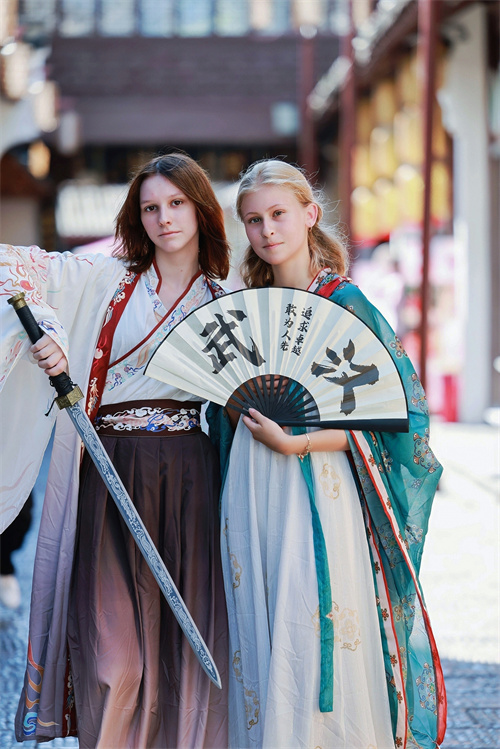
Before coming to China, 17-year-old Russian student Ilkhan Fayzullin saw the country as "ancient and distant".
His image of China was shaped by scattered impressions — the Great Wall, kung fu and other familiar symbols.
"But this summer, after actually coming here, I saw a country that is both historic and modern," he said.
Fayzullin was among 17 middle school students from across Russia who joined a Chinese language and culture summer camp in Wuhan, Hubei province, from Aug 22 to 27.
Organized by the Chinese embassy in Russia and hosted by Central China Normal University (CCNU), the camp was held under the framework of the China-Russia Years of Education, which runs from 2026 to 2027.
The program combined traditional cultural experiences with exploration of science and technology, said Wang Tianxiong, project manager with CCNU's department of global engagement.
Unlike Fayzullin, 15-year-old Vidana Usova never regarded China as unfamiliar.
"My hometown, Vladivostok, is close to China, so it feels more like a neighbor living next door," she said.
Yet the camp showed her that this neighbor was far more multifaceted than she had imagined.
During the trip, Usova practiced tai chi, listened to bianzhong, or bronze chime bells, at Hubei Provincial Museum and visited the Yellow Crane Tower, one of Wuhan's best-known landmarks.
She also built a model using the sunmao technique (traditional Chinese mortise-and-tenon joinery), in which wooden components interlock without nails.
"At that moment, I felt like I was touching the wisdom of ancient Chinese builders," she said.
For 14-year-old Sofia Radzhabova, an ocarina lesson offered another way to engage with Chinese culture.
Having studied the flute since childhood, she was surprised to find similarities between the two wind instruments, despite their different playing techniques. But she was most intrigued by how ocarinas were made. In class, an instructor showed them that the instrument could be crafted from a range of materials, including stone, wood and even walnut shells.
"I watched the instructor shape a piece of clay into a small ocarina, and after it was processed, it could produce sound. I found it amazing," Radzhabova said.
Beyond traditional culture, the Russian students also encountered a side of China that challenged another set of expectations.
Alexandra Vazhenina, 14, had seen Chinese robots before. In St Petersburg, she once watched robots sing and dance at a concert. At technology companies in Wuhan, however, she saw robots doing far more than entertaining people — they transported goods and assisted with everyday tasks, while robotic dogs greeted visitors and interactive robots responded to questions.
"I asked a robot, 'Can you sing?' It sang a Chinese folk song for us," Vazhenina said. "It was really cute."
Fayzullin, meanwhile, was impressed by smart manufacturing facilities, where he watched robotic arms perform tasks including welding, inspection, packaging and assembly.
"The entire production process required almost no human intervention," he said. "Everything looked like something from a science fiction movie."
For Anastasiia Tikhomirova, 27, the group leader and a Chinese language teacher at a Russian middle school, the most meaningful change was not simply that her students experienced China firsthand, but that they put what they had learned from textbooks into practice.
"Seeing students use Chinese to talk about what they discovered here is exactly what I hope for as a teacher," she said. "Language has truly become a tool for communication, rather than simply something tested in exams."
That communication also gave the Chinese students accompanying the group an opportunity to think differently about how they introduced their own culture.
Yang Yijia, 21, a student majoring in Russian at CCNU, found that familiar comparisons could sometimes bridge cultural differences more effectively than complex explanations.
For example, when introducing the bianzhong unearthed from the tomb of Marquis Yi, ruler of the ancient state of Zeng, she compared the ensemble of bells, each producing different tones, to a symphony orchestra.
"Different civilizations share common emotions and experiences rooted in humanity and daily life," Yang said.
"These connections can quickly bring people closer."





