Japan bids farewell to panda twins
Fans of Xiao Xiao and Lei Lei welcome to visit China, says Foreign Ministry spokesman
By HOU JUNJIE in Tokyo | China Daily Global | Updated: 2026-01-28 09:53


Emotions ran high at Ueno Zoological Gardens in Tokyo, Japan, on Tuesday as giant panda fans gathered in large numbers to bid a fond farewell to twins Xiao Xiao and Lei Lei as they left Japan for China, marking the first time in about half a century that the East Asian neighbor is left without any of these beloved bears.
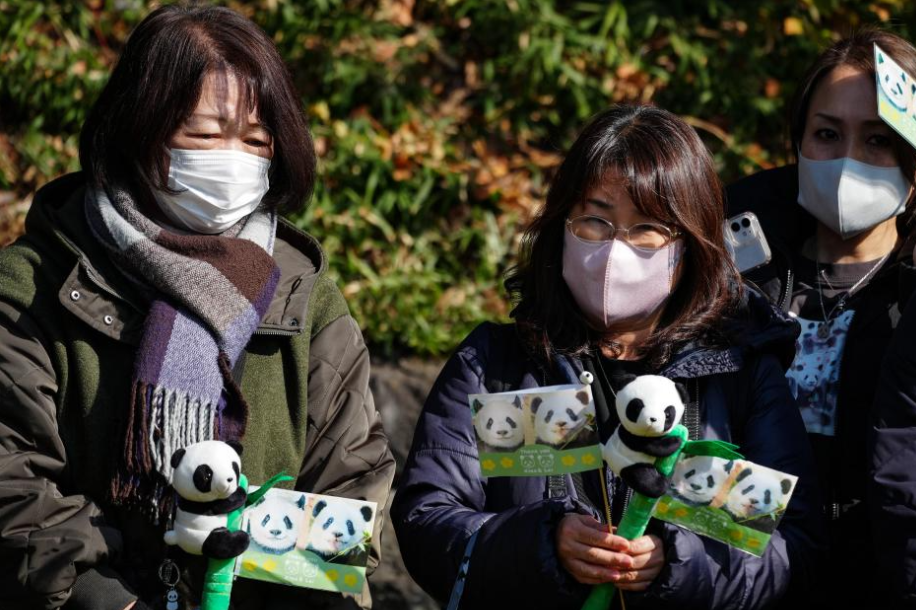
Visitors carrying panda-themed accessories stood in long lines outside the zoo since noon to catch a glimpse of the twins, with many saying that they would be glad to just wave goodbye from a distance and others hoping that someday they will be able to travel to China to see these pandas again.
Noriko Tezuka, a Tokyo resident, who was carrying a backpack full of panda plush toys, said on Sunday that she wanted to feel close to Xiao Xiao and Lei Lei by just being there, even if she didn't manage to see them one last time.
The panda twins left Ueno zoo for Narita International Airport in the afternoon, and were scheduled to board a flight to China later in the night, Chinese media reported. According to Kyodo News, they are expected to arrive on Wednesday at a facility in Sichuan province, where their mother, Xian Nyu, and elder sister, Xiang Xiang, live.
After Japan announced on Dec 15 that Xiao Xiao and Lei Lei would leave for China, the number of visitors to the zoo increased significantly. To manage the swelling crowd, the zoo introduced an online reservation system the same month, limiting daily admissions.
Sunday marked the final public appearance of the pandas at Ueno zoo, with each visitor given roughly one minute to see them.
Addressing a regular news briefing in Beijing on Tuesday, Chinese Foreign Ministry spokesman Guo Jiakun said that based on a relevant agreement between China and Japan, giant pandas Xiao Xiao and Lei Lei have embarked on their journey to China.
"We, as always, welcome Japanese friends to come visit giant pandas in China," Guo added.
China's panda conservation program with Japan has been widely regarded as successful, advancing cooperation in breeding, veterinary care and public education. More than 30 giant pandas were either sent on loan to Japan under the program or were born there.
Doi Toshimitsu, president of a panda protection institute in Japan and former director of Ueno zoo, said the arrival of the first pandas in 1972 symbolized the normalization of Japan-China relations, adding that the beloved bears will continue to be an enduring symbol of friendship and cultural exchange between the nations.
In the Ueno area in central Tokyo, panda-themed products, including plush toys, accessories, souvenirs and snacks, have been synonymous with brisk business over the years.
After the departure of Xiao Xiao and Lei Lei was announced in December, nearby shopping streets and department stores launched panda-themed promotions, selling desserts and merchandise modeled after the bears.
Toshimitsu said that giant pandas, with their exceptional public appeal, not only increased the number of visits to the zoo, but also had a positive spillover effect on the local economy, driving the growth of panda-themed food and cultural businesses.
Miyamoto Katsuhiro, professor emeritus of economics at Kansai University, said the absence of any pandas at Ueno zoo would lead to estimated annual economic losses of at least 15.4 billion yen ($100 million), affecting nearby hotels, restaurants and souvenir shops.
Since the first pair of giant pandas arrived in 1972, the zoo has housed 15 of these bears. When Xiao Xiao and Lei Lei were born on June 23, 2021, celebrations extended beyond the zoo premises into the surrounding neighborhoods, becoming a shared memory for the local community.
Xiang Xiang, the elder sister of the twins, left for China in February 2023, and their parents, Bi Li and Xian Nyu, followed in September 2024. In June last year, four giant pandas at Adventure World in Wakayama prefecture were also sent back to China, making the Ueno twins Japan's last remaining pandas.
houjunjie@chinadaily.com.cn