China opens trade shortcut to SE Asia
Pinglu Canal expected to drive further opening-up of western region
By ZHANG LI in Qinzhou, Guangxi, and LUO WANGSHU in Beijing | China Daily | Updated: 2026-09-17 07:33


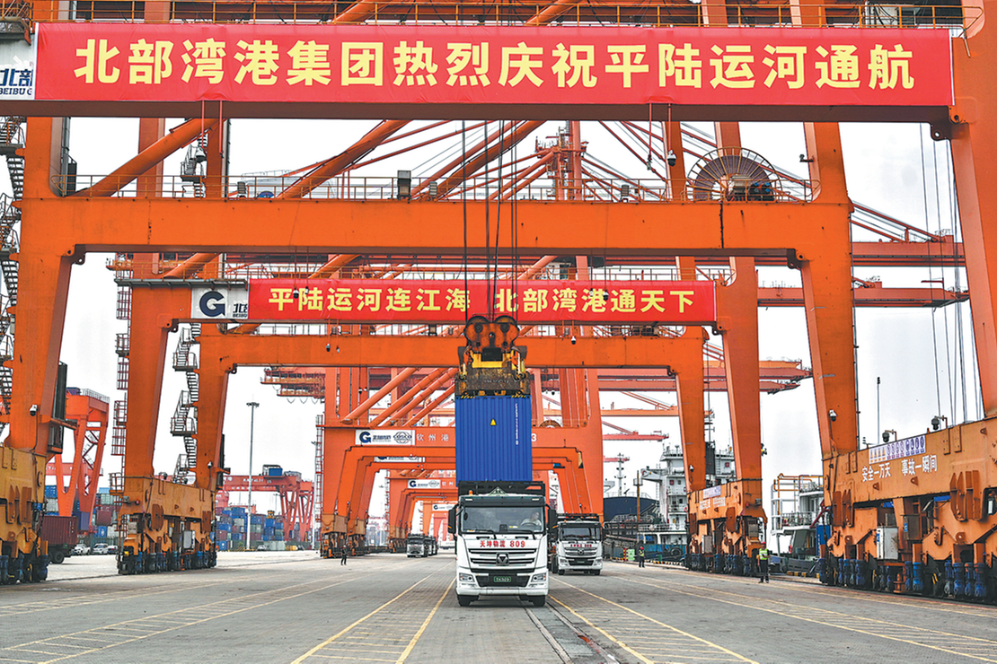
China opened a vital waterway on Wednesday, giving its landlocked southwestern areas a shortcut to the coast and overseas markets, as the country moves to further strengthen its trade relations with regional neighbors, particularly those in Southeast Asia.
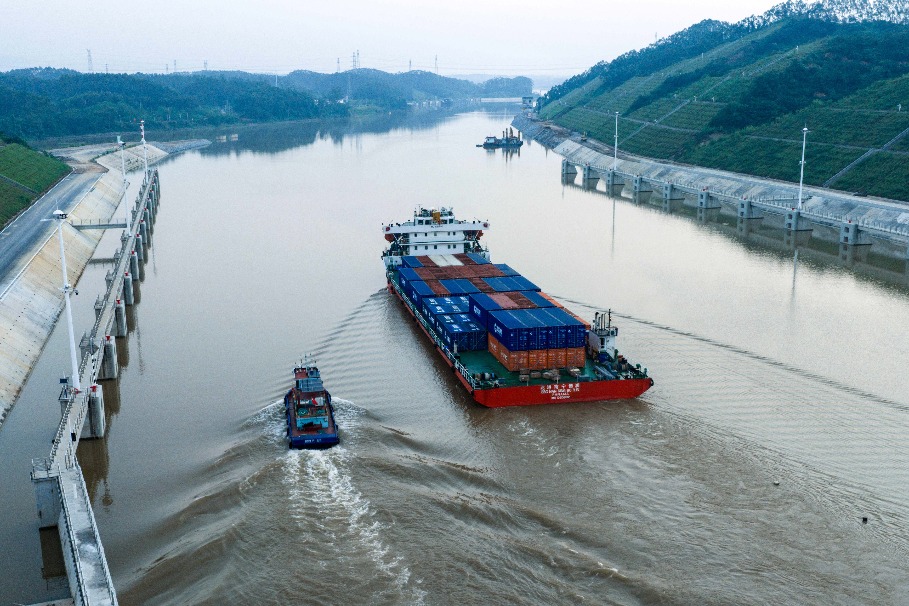
The Pinglu Canal, built in the Guangxi Zhuang autonomous region at a cost of 72.7 billion yuan ($10.8 billion), stretches for 134.2 kilometers from the Xijin reservoir in the county-level city of Hengzhou to the Qinzhou Port in the Beibu Gulf. It is the first waterway built in the country to connect a river system directly to the sea since the founding of the People's Republic of China in 1949.
The canal shortens the inland waterway journeys of goods from southwestern China by more than 560 km compared with traditional routes through ports in Guangdong province. It is expected to reduce overall logistics expenses and save more than 5 billion yuan in transportation costs each year.
Vice-Premier Ding Xuexiang, who attended the canal's opening ceremony, called for making full use of the new waterway to develop a first-class international gateway port in the Beibu Gulf and support further opening-up of China's western region.
Ding also called for efficient operation of the canal, which serves as key infrastructure for multimodal transportation integrating river, rail and sea, and is a backbone project of the New International Land-Sea Trade Corridor — a strategic route connecting China's inland areas with regional and global markets.
Construction of the Pinglu Canal started in August 2022 to address a long-standing geographical problem in terms of trade.
While Guangxi boasts a coastline and borders Vietnam, its major inland rivers flow east, which means cargo moving by water from Nanning, the capital of Guangxi, and other parts of the Xijiang River basin could only reach the sea through Guangdong.

The Pinglu Canal, designed to handle vessels of the 5,000-metric-ton class, now allows cargo to turn south and reach the Beibu Gulf — the closest maritime outlet for much of southwestern China — through the Qinzhou Port.
One of the biggest engineering challenges during construction of the canal was navigating a difference of 65 meters in the water level between its northern end and the sea. Three navigation hubs — Madao, Qishi and Qingnian — featuring twin-line ship locks were built to raise and lower vessels, effectively acting as giant elevators.
Ni Yuping, vice-dean of Tsinghua University's School of Humanities in Beijing, placed the megaproject in a broader context, saying that one of the key questions it seeks to answer is "how western China can better integrate into the global economy".
Unlike the Suez Canal and the Panama Canal, which primarily provide shortcuts for vessels between major seas and oceans, the Pinglu Canal gives a vast inland economic hinterland a shorter route to the coast — and from there to international markets.
Wu Tao, a history professor at Sun Yat-sen University in Guangzhou, the capital of Guangdong, noted that inland waterway shipping routes "remain irreplaceable" even though China's road, rail and air transportation networks have expanded. Their large carrying capacity and relatively low logistics costs make inland waterways particularly suited for bulk cargo, Wu said.
For businesses, the new canal is already dictating logistics and investment decisions.
On Sept 8, a consignment of auto parts from Chinese vehicle manufacturer SAIC-GM-Wuling left Liuzhou for Nanning Port, before continuing by ship through the Pinglu Canal to reach Can Tho Port in Vietnam.
The company said the new river-sea route could cut its logistics costs by about 10 percent. "For us, the freight saved is real profit, and that translates directly into greater price competitiveness in ASEAN and other global markets," said Cai Yan, a senior technical officer at SAIC-GM-Wuling.
The canal has added waterway to the company's existing road and rail transportation options, giving it more flexibility as it expands its business and production links across Southeast Asia, Cai said.
The new route is being factored into investment plans of companies.


About 50 km from the Pinglu Canal's northern end, French chemicals producer SNF Group is building a plant in Nanning's Liujing Industrial Park, with an annual capacity of 370,000 tons.
The factory, which will be the group's largest production base in southern China, is expected to start operations in stages before June 2027.
"The Pinglu Canal will reduce our logistics costs and enable convenient delivery to South China and all of Southeast Asia. It offers great advantages in both materials sourcing and product distribution," said Thomas Wilsius, head of the company's Nanning project.
The waterway is likely to bring more Southeast Asian products to the Chinese market.
Philippine Ambassador to China Jaime A. FlorCruz, who visited the canal with a group of ASEAN envoys in July, said that fresh seafood and other time-sensitive products could be exported more efficiently from his country to China.
"In the long run, this will benefit not only the local people, but the broader region and even the world," he said, adding that shorter shipping distances, lower freight costs and faster deliveries would bring tangible benefits to fishermen, farmers, traders and entrepreneurs.
For Shen Guiping, a resident of Shangjing village in Qinzhou, who took part in relocation work for the project, the opening of the Pinglu Canal carries a more personal meaning.
"It almost feels like a dream that has finally been realized. It is something generations of locals hoped for," she said.
Contact the writers at luowangshu@chinadaily.com.cn

Related Stories
- Over 3,400 companies to participate in the 23rd China-ASEAN Expo
- New infrastructure opens opportunities for Taiwan businesses
- Blue economy is the next key phase of China-ASEAN economic integration
- China vows greater cooperation with ASEAN nations
- Golden waterway opened to fast link China's southwest with the sea





Editor's Pick