Commemorating Confucius holds modern meaning
By YANG FEIYUE and ZHAO RUIXUE in Jining, Shandong | China Daily | Updated: 2026-09-29 06:19


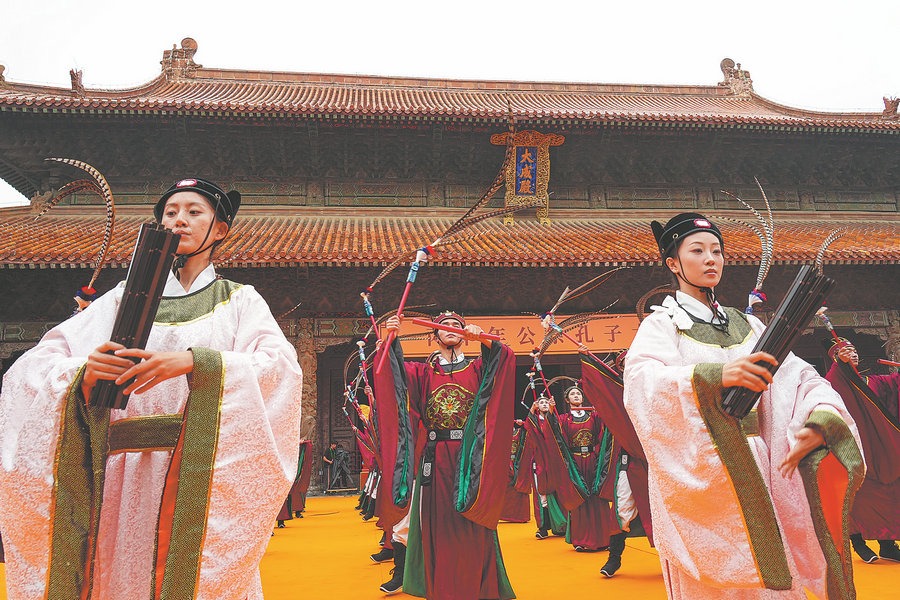
The words of The Analects of Confucius rose into the autumn air, set to music at the Confucius Temple in Qufu, a county-level city in Jining, Shandong province, on Monday, as people stepped forward with flower baskets and bowed during a ceremony, which was part of a ritual that has continued in various forms for centuries in the hometown of the philosopher who lived more than 2,500 years ago.
"It's very interesting, lively," said Jonah Dunch, a Canadian graduate student studying Chinese philosophy at Peking University in Beijing, who attended the 2026 Memorial Ceremony for Confucius.
He was visiting Qufu for the Nishan Forum on World Civilizations, and said that the ceremony offered a glimpse into how Confucian traditions are being carried into the present.
"You could see an interesting mix of ancient practices and texts, and modern things as well," Dunch said, adding that the experience gave him a sense of the influence Confucius continues to have in Chinese culture.
"I can see that Chinese people respect Confucius," he said.
This year marks the 2,577th anniversary of the birth of Confucius, an influential educator and philosopher whose teachings became the foundation of Confucianism, shaping Chinese society and thought for generations. He advocated teaching students regardless of their social background.
The tradition of commemorating Confucius began in 478 BC, a year after his death, and has evolved to feature ancient music, ceremonial dances and traditional rituals.
The gathering was part of this year's China International Confucius Cultural Festival, which is themed "For a World of Shared Peace and Harmony with Benevolence and Ancient Rituals". The festival drew about 300 participants from 44 countries and regions, including foreign dignitaries, diplomats, UNESCO Confucius Prize laureates, overseas travel agents and young Sinologists.
The festival runs through Oct 7, taking Confucian culture to the world through study tours, bringing it into everyday life through temple fairs, promoting the reading of Confucian classics worldwide, and following Confucius' legacy along the Grand Canal.
Wang Jiayi, vice-minister of education, highlighted Confucius' longstanding influence as an educator, citing principles including "education for all without discrimination", "teaching according to aptitude" and "learning with constant practice".
Wang said that these ideas continue to have relevance today.
He also referred to the UNESCO Confucius Prize for Literacy, established in 2005 with funding from Shandong. Over the past two decades, the prize has recognized dozens of literacy initiatives.
This year's recipients from Lebanon, Mexico and Thailand have worked with out-of-school youths, women and indigenous communities through non-formal education, bilingual literacy programs and multilingual learning, Wang said.
"They are living examples of Confucius' idea of education for all," he said.
Spiritual pursuits
Lin Wu, secretary of the Shandong Provincial Committee of the Communist Party of China, said that Confucian thought took root in China and reflects the spiritual pursuits of the Chinese nation, embodying the distinctive charm of Chinese civilization.
He said that the emphasis of Confucian thought on benevolence and harmony in diversity, as well as The Doctrine of the Mean, could offer important inspiration for addressing global challenges and problems facing humanity today.
"As the world changes rapidly, people expect to meet through culture," Lin said, describing the festival as a platform for cultural exchange and mutual learning. He also emphasized the importance of preserving cultural diversity and ensuring that traditional culture remains connected to contemporary life.
In a video address to the Nishan Forum on World Civilizations, which this year focuses on "Civilization, Order and Justice", Thomas Bach, ninth president and honorary president for life of the International Olympic Committee, drew a connection between Confucian thought and the values of the Olympic movement.
Bach recalled his visit to Qufu several years ago, saying that it gave him an opportunity to see firsthand the common ground between Confucian thought and the Olympic ideal.
Confucius recognized the importance of cultivating both body and mind, Bach said, an idea that also finds an echo in the ancient Roman maxim about "a sound mind in a sound body". He welcomed the forum's efforts to explore connections between civilizations and cultures, saying that dialogue has become increasingly important in a divided world, and called for a shared spirit of understanding and peaceful coexistence.
Suos Yara, chairman of the Commission on Foreign Affairs, International Cooperation and Information of the National Assembly of Cambodia, said that the forum's theme was particularly relevant to a world facing rapid technological changes, growing interdependence and a series of interconnected challenges.
He said that civilization gives people a sense of identity and wisdom, while order creates the conditions for peaceful coexistence and justice helps sustain that order.
The Nishan forum provides an opportunity to draw on different civilizational experiences and perspectives in addressing challenges that no country can tackle alone, he said.
The contemporary value of Confucianism, global governance, artificial intelligence and other issues concerning humanity's future are among the topics being discussed.
Related Stories






Editor's Pick