Innovation in China driving global growth
Positive sentiment among businesses reflected in foreign investment figures
By ZHANG CHENXU and ZHOU LANXU in Tianjin | China Daily | Updated: 2026-10-31 06:42


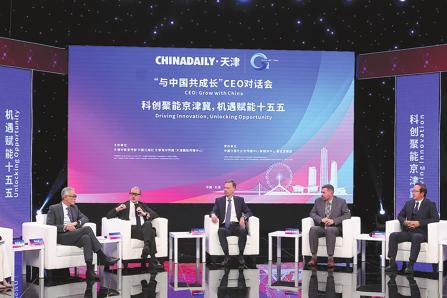
China's growing role as a source of global innovation is paying substantial dividends for international businesses, as the country remains committed to nurturing new quality productive forces and promoting greater market openness, a roundtable in Tianjin heard on Friday.
The Beijing-Tianjin-Hebei region, a major economic engine in northern China, is at the forefront of the country's innovation drive, drawing on regional integration and international collaboration to spur growth, business executives and economists said.
They made the remarks at the "CEO: Grow with China" roundtable, which was jointly organized by the Publicity Department of the Tianjin Municipal Committee of the Communist Party of China, China Daily and Tianjin Haihe Media Center.
"Over the past few years, I have witnessed the ongoing transformation in China — from 'world's marketplace' into a 'global source of innovation'," said Claus Zieler, chief commercial and medical affairs officer at Astellas.
The global drugmaker inaugurated its first innovation R&D center in China on Wednesday, completing a local value chain spanning research and development, manufacturing, sales and trade, he said.
Astellas' growing presence in China is not an isolated phenomenon, but a reflection of the world's second-largest economy's sustained policy support for innovation.
At the Central Economic Work Conference held in December, there were calls to develop an international technological innovation center in Beijing (Beijing-Tianjin-Hebei region), with the region's stated aim being to become a world-class innovation engine by 2030.
Speaking at the event, Xu Gang, executive deputy head of the Publicity Department of the CPC Tianjin Municipal Committee, said Tianjin is playing an active role in building the regional innovation center.
Zhao Zhongxiu, a professor and former president of the University of International Business and Economics in Beijing, said the regional initiative is expected to forge closer ties between research and industry.
"Competition in innovation increasingly extends to the capacity to bring scientific discoveries into productive use," Zhao said, adding that closer integration between scientific research and industrial innovation would create important opportunities during the 15th Five-Year Plan (2026-30) period.
That connection between innovation and industry is also central to China's appeal among international businesses. "China's greatest opportunity for international business is no longer simply the size of its market, but its extraordinary capacity to transform innovation into industrial applications," said Gianni Di Giovanni, chairman of energy company Eni China.
The ability to connect research, engineering, manufacturing and market demand gives China a fundamental competitive advantage, he said.
According to Teo Eng Cheong, CEO of Sino-Singapore Tianjin Eco-City Investment and Development Co, companies can turn the country's wealth of scenarios and supply chain capabilities into competitive advantages, moving from "technology import" to "co-innovation" and contributing to global markets.
This view was echoed by Gou Jianhui, chairman and CEO of Flender China, who sees the most compelling opportunity in "two-way collaboration: innovate in China, empower the world".
The positive sentiment is reflected in China's foreign investment figures, with inflows into high-tech industries rising 33.8 percent year-on-year in the first nine months and accounting for 41.6 percent of the national total, according to the Ministry of Commerce.
The confidence to invest also rests on an open and predictable business environment, which China is redoubling its efforts to provide as geopolitical risks and protectionism weigh on the global economy.
Simon Lacey, founder of Market Access X, said China is moving in a genuinely positive direction in advancing high-standard opening-up.
Gou from Flender China voiced similar confidence, saying the country's continued opening-up and improvements in its business environment send businesses a clear message of stability and long-term prospects.
Tianjin, the roundtable's host city, is also pressing ahead with greater opening-up while working to improve its business environment.
Andries De Bock, general manager of Leybold Equipment (Tianjin) Co, said a sound business environment is important for manufacturers, adding that his company's experience in the city has been positive.
"Tianjin has become the largest open coastal city in northern China, with R&D spending reaching 3.47 percent of GDP, the fifth-highest level nationwide," said Ma Bo, president of Tianjin Haihe Media Center.
"We welcome entrepreneurs from China and abroad to invest and innovate in Tianjin and pursue growth opportunities across the Beijing-Tianjin-Hebei region," said Xu from the Publicity Department of the CPC Tianjin Municipal Committee.
Ren Qi, Li Jiaying, Tan Guoling and Wang Yubo contributed to this story.



Editor's Pick