City cleans up to showcase sustainability credentials
By ZHANG LINWAN | CHINA DAILY | Updated: 2026-04-23 16:11


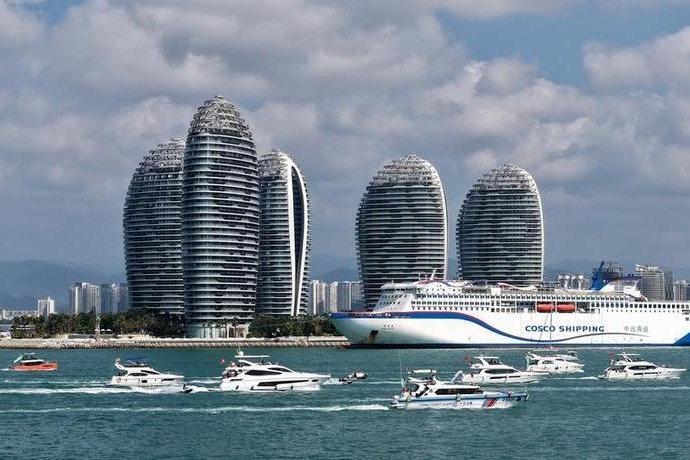
The sixth Asian Beach Games, which started on Wednesday in Sanya, Hainan province, embrace zero-waste practices and sustainable principles, showcasing the charm and beauty of the coastal city.
According to the organizing committee of the Games, Sanya has incorporated zero-waste philosophies into all procedures of the event's preparation and operation, in order to establish a highly efficient resource recycling system and host an eco-friendly sports gala with distinctive Hainan characteristics.
In terms of construction, the event set up a total of eight venue clusters, including an array of renovated facilities, prefabricated buildings, as well as rainwater collection systems.
Eco-friendly materials such as recycled aluminum and bamboo are widely used, ensuring both venue quality and minimal impact on the environment, local officials said.
The event also introduced 970 new energy vehicles for transportation services, which can achieve precise scheduling and route optimization based on intelligent systems,thereby cutting energy consumption and carbon emissions.
Meanwhile, spectators are encouraged to take public transport and reduce waste during the Games. Organizers said they have added recycling points around the venues and will distribute trash bags to audience members.
The competition's catering sector gives priority to local agricultural products and offers smaller portions, while using reusable tableware and implementing the resource-efficient treatment of kitchen waste.
"Local ingredients are not only fresher,but also help lower carbon emissions during transportation," said Duan Wenjing from Sanya Conifer Resort, a designated hotel of the Games.
All the event's 22 designated hotels have adopted a policy to reduce the frequency of changing and washing bed linens and do not offer disposable toiletries including toothbrushes, toothpaste, combs and slippers, unless requested by guests.
To improve the efficiency and environmental performance of the Games, a closed-loop solid waste management system has been established, enabling the traceability of all waste flows.
A coordinated land-sea cleaning mechanism is also in place, featuring teams that regularly clean beaches and nearshore waters and remove floating debris, ensuring a clean competition zone for athletes.
Additionally, the Games have deployed a life-cycle carbon emissions calculation system to assess emissions reduction effects through data, such as the use of eco-friendly materials and waste recycling rates.
Ye Kaizhong, a senior official from the Sanya investment promotion bureau, said that the event is a key opportunity for the city to demonstrate its determination and achievements in ecological conservation and sustainable development.
The city would spare no effort to implement these measures, make the international sporting event a benchmark of green, low-carbon practices and contribute its strength to the global zero-waste city initiative, Ye said.
As one of the United Nations' "20 Cities Towards Zero Waste", Sanya upholds zero-waste principles in all aspects of urban governance, demonstrating a model mechanism for coastal cities worldwide.
To address large seasonal fluctuations in waste volume, a common challenge for tourist cities, the city has set up a full-chain system covering source reduction, sorting and recycling, resource utilization and harmless disposal.
It has also built a 200-hectare circular economy industrial park which can achieve the integrated treatment of multiple types of solid waste, thereby cutting carbon emissions through energy sharing.
Zero-waste cells and land-sea coordinated control are two highlights of Sanya's zero-waste efforts.
Official data showed that by the end of March, there were 676 zero-waste cells in the city, involving numerous scenarios such as hotels, scenic spots and islands.
Local authorities have released mandatory regulations that prevent fishing vessels from dumping garbage generated onboard into the sea. Instead, they must bring the waste back to port for proper disposal.
Utilizing intelligent facilities such as drones and cleaning robots, the environment sector has also developed an integrated cleaning network that spans the seabed,water surface and beaches.
Moreover, enterprises, schools and communities have all been mobilized to join in beach cleaning and other zero-waste activities, fostering a sense of environmental responsibility across society.
zhanglinwan@chinadaily.com.cn




Editor's Pick