Shanghai sets target to build intl shipping hub
By WANG YING in Shanghai | China Daily | Updated: 2026-05-18 09:19


As Shanghai moves from scale expansion to capacity enhancement in building an international shipping center during the 15th Five-Year Plan (2026-30) period, demand for talent with cross-disciplinary expertise is rising, according to experts.
The port of Shanghai, the world's largest container port for 16 consecutive years, handled 55.06 million twenty-foot equivalent units (TEUs) throughout 2025, and is targeting an annual container throughput of 58 million TEUs during the 15th Five-Year Plan period, Chu Beiping, president of Shanghai Maritime University, said at the Shanghai International Shipping Center Capacity Enhancement Think Tank Forum held recently in Shanghai.
"The growth in scale is merely part of the capacity enhancement in the development of the Shanghai International Shipping Center. More important are talent supply, rule-making capacity and competition for international discourse influence, which are key to elevating the center's status and capability," Chu said at the forum, which was jointly held by the Shanghai Federation of Social Science Association and Shanghai Maritime University.
Chu said future efforts should focus on the emerging needs of the shipping industry by developing new interdisciplinary fields, jointly cultivating professionals with cross-disciplinary integration capabilities, and building a knowledge hub that is demand-driven, collaboration-based and underpinned by standards development.
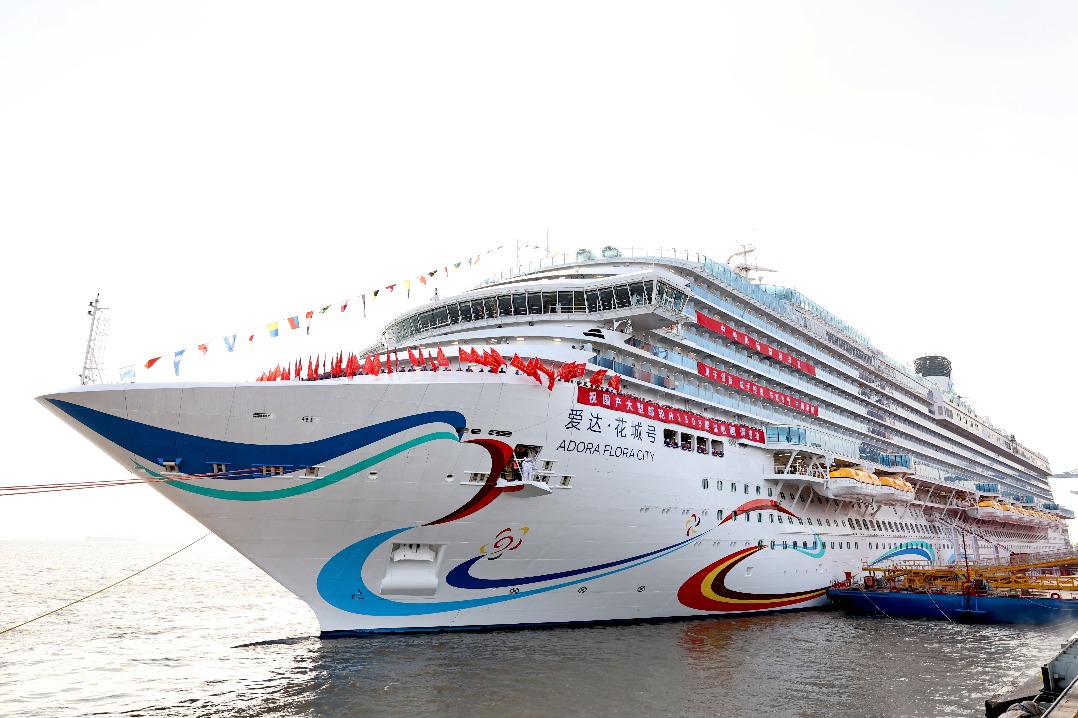
Against this backdrop, Shanghai Maritime University launched the country's first undergraduate program in international cruise management in 2025, enrolling 31 students, a move expected to help address Shanghai's shortage of high-end maritime service talent, said Wu Xianhua, dean of the university's School of Economics and Management.
"Through the integration of industry and education, the bachelor's program aims to sharpen students' practical skills, foreign-language proficiency and international outlook," Wu said.
According to Wu, the program is in response to China's fast-developing cruise economy, which is evolving from a pure cruise consumer market into a comprehensive industrial chain spanning construction, independent design and operations.
"The undergraduate program is designed to fill the significant gap in medium — to high-end cruise management talent in China, and is expected to become a stable source of high-quality talent supporting Shanghai's development as an international shipping center," Wu said.
"Taking a medium-sized cruise ship as an example, there are at least 1,000 crew members onboard on a regular basis, with mid — to high-level management talent accounting for more than 5 percent," Wu added.
Representing the highest level of China's shipping center development, Shanghai serves as a stabilizer in global port and shipping development, supporting China's opening-up and supply chain stability, said Liu Xin, director of the Transport Planning and Research Institute.
"To become a globally leading international shipping center, Shanghai should strengthen its soft power during the 15th Five-Year Plan period," Liu said.
According to Liu, the focus will be on enhancing four key capabilities: facility resilience and safety, global shipping resource allocation, leadership in intelligent and green development, and comprehensive financial and legal support.
"Shanghai should strive to achieve comprehensive leadership in scale and efficiency, resilience and security, integrated services, intelligent and green development, and economic vitality," Liu added.
wang_ying@chinadaily.com.cn





Editor's Pick