Chinese carriers ink major fleet purchases
Airlines announced orders for 476 Airbus aircraft in past seven months
By Li Jing | China Daily | Updated: 2026-07-24 08:53


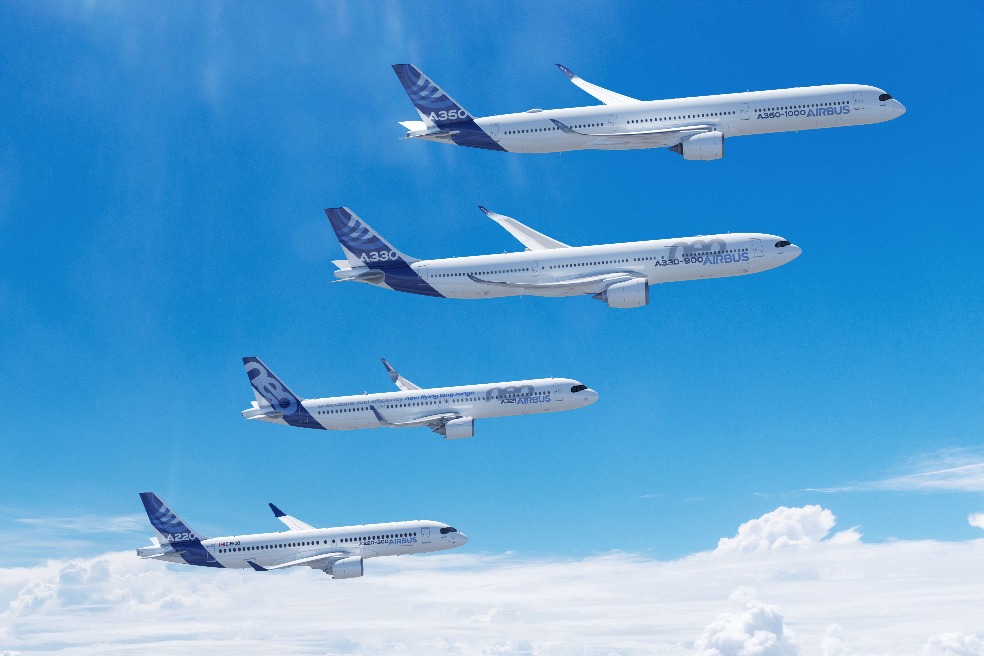
Chinese airlines have announced orders for nearly 500 Airbus aircraft over the past seven months, underscoring the industry's confidence in long-term travel demand even as high fuel prices and external volatility weigh on near-term earnings.
Last week, Air China, its subsidiary Shenzhen Airlines, alongside Hainan Airlines, announced agreements to purchase a combined 95 Airbus aircraft with a catalog value of about $17.8 billion, adding to a series of large Airbus orders by Chinese carriers earlier this year.
Combined with earlier purchases by China Southern Airlines, Xiamen Airlines and China Eastern Airlines, domestic carriers have announced orders for 476 aircraft from the European manufacturer since the end of last year, according to company filings.
The buying spree persists despite warnings from major airlines including Air China, China Southern Airlines and China Eastern Airlines of substantial first-half losses as rising operational costs erased their first-quarter profits.
Industry analysts said that while airline profitability fluctuates with fuel prices, exchange rates and geopolitical events, aircraft purchases are a strategic fleet planning exercise extending over a decade or longer.
"Current losses are a short-term phenomenon, driven mainly by external factors beyond airlines' control," said Guo Jia, a civil aviation expert and professor at Guangdong University of Foreign Studies' South China Business College. "Aircraft procurement is part of airlines' broader, long-term strategic vision."
The latest aircraft are scheduled for delivery between 2028 and 2032. The multiyear delivery timeframes spread capital expenditure over time, mitigating the immediate financial impact of the purchases. Air China said in its filing that the transactions would not materially affect the company's cash flow or operations over the near term.
Although newer aircraft such as the A320neo family and A350 consume less fuel than previous generations, Guo said this is merely one benefit rather than the decisive driver behind the recent buying spree.
"The core driver of this round of orders is that Chinese airline fleets have entered a renewal cycle. With many aircraft having remained grounded during the COVID-19 pandemic, maintaining a younger fleet is a priority. It is fundamentally a medium to long-term capacity optimization rather than short-term capacity expansion."
The orders also reflect carriers' efforts to secure scarce production slots years in advance as global aircraft manufacturers continue to grapple with supply-chain disruptions. Deliveries of popular narrow-body models have already been largely sold out for several years, prompting airlines worldwide to place orders well ahead of expected demand.
The Civil Aviation Administration of China has projected annual passenger traffic will reach 1.5 billion by 2035, compared with about 770 million passengers carried in 2025, implying substantial room for long-term growth in the country's commercial aviation market.
Boeing expects that expansion to be mirrored globally. In its latest commercial market outlook released on Saturday, the US aircraft maker forecast that global passenger traffic will double over the next two decades, requiring 43,625 new commercial aircraft. Emerging markets, including China, Southeast Asia, South Asia, the Middle East, Africa and Latin America, are expected to account for about 55 percent of new deliveries.
However, the robust new orders do not guarantee that aircraft will arrive on schedule. Across the industry, manufacturers are facing growing constraints from shortages of engines, components and maintenance capacity, slowing deliveries even as travel demand remains robust.
The International Air Transport Association warned in June that durability problems and shortages of spare parts are disrupting airline operations worldwide.
"Engine maintenance, repair and overhaul bottlenecks are disrupting airline operations," Willie Walsh, IATA director general, said as the industry group released a joint study with consultancy Emerton in June. "Without significant changes, this will only get worse as the fleet of latest-generation single-aisle aircraft grows."
The report found that airlines have increasingly been forced to retain older aircraft, extend leases or source additional aircraft while waiting for engines, spare parts or maintenance slots.
Guo added that these bottlenecks are now affecting all major aircraft manufacturers, including Airbus, Boeing and Commercial Aircraft Corporation of China (COMAC).
COMAC this week showcased models of the C909 regional jet, the C919 narrowbody and the C929 widebody aircraft at its booth at the ongoing Farnborough International Airshow in Farnborough, Britain, highlighting its ambition to expand its commercial aircraft portfolio.
Guo dismissed concerns that Chinese airlines' Airbus purchases would crowd out the C919.
"The issue is not how manufacturers divide market share. COMAC has accumulated more than 1,500 orders and commitments for the C919, a sizeable order book for a relatively new aircraft program. Like its rivals, the company's primary challenge is expanding production capacity while strengthening its supplier network."








Editor's Pick