Farmers in Northeast China transform lives through smart agricultural tech
By ZHOU HUIYING and TIAN XUEFEI in Jiamusi, Heilongjiang | China Daily | Updated: 2026-09-16 09:33


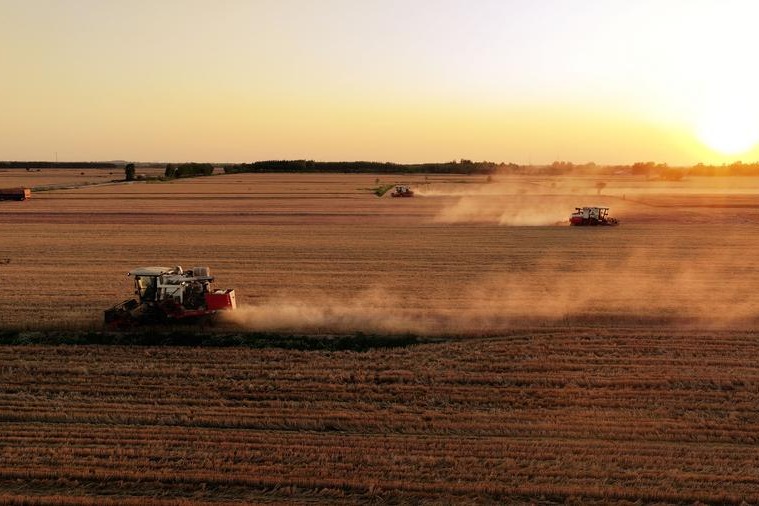
As the golden autumn days set in, the fertile black soil fields of Northeast China's Heilongjiang province are alive with waves of ripening grains.
Standing in his rice field at Qixing farm under Beidahuang Group's Jiansanjiang branch, farmer Liu Xianzhong's eyes are filled with the joy of a bountiful harvest.
"Thanks to the Jiajianong smart agricultural service platform, I am embarking on a new life of farming with data," said the 57-year-old who has been cultivating rice at the farm for over 20 years.
"In the past, we inspected the fields and assessing agricultural tasks relied entirely on accumulated experience," he said. "Now, with just a swipe on the smartphone screen, the platform can display the moisture levels, crop growth and pest warnings of my 160 mu (10.67 hectares) of rice fields at a glance."
In May 2025, with the promotion of the management committee of Jiamusi National Agricultural Hightech Industry Demonstration Zone, Liu downloaded and started using the app.
"The operation of the app is very simple," he said. "With the guidance of the technicians, it was easy for us to master it ... Via the app, satellite remote sensing can directly send me the field conditions. I can also get a treatment plan immediately after uploading a photo of a disease on the rice paddy."
"Last year, my rice yield reached 9,750 kilograms per hectare, achieving a net profit of 7,500 yuan ($1,117) per hectare," said Liu. "Digital technology is truly safeguarding farmers' income."
As an artificial intelligence smart agricultural service platform tailored for cold-region agriculture, Jiajianong was jointly developed by the Jiamusi National Agricultural High-tech Industry Demonstration Zone and the Institute of Computing Technology of the Chinese Academy of Sciences.
It connects the collaborative innovation chain of government, research, and enterprise, transforming cutting-edge laboratory technology into accessible production tools for ordinary farmers.
Chen Haihua, a senior engineer at the institute and deputy director of the management committee, explained that the platform establishes a unique data ID for each plot of farmland, creating a citywide agricultural map.
"Satellite remote sensing updates field growth every seven days, with abnormal growth directly marked with red warnings," said Chen. "Weather forecasts have improved precision to one square kilometer, providing accurate warnings for hail, heavy rain and other disasters."
Furthermore, subsidy verification is handled with big data, eliminating the need for extensive manual field inspections.
Farmers can complete field inspections, pest identification, receive agricultural advice and book aerial prevention machinery operations without leaving home.
Since its official launch in May 2025, nearly 60,000 farmers have regularly used the platform, and it serves over 466,666 hectares of farmland.
In Heilongjiang, the practice of digital agriculture is not limited to Jiajianong.
Beidahuang Information Co is focused on empowering the digital development of the agricultural industry in Heilongjiang.
Relying on the Heluo digital base, the company has developed three core business scenarios — digital management, digital agricultural services and smart farms.
The company has independently developed over 60 digital systems, with a self-research rate of over 90 percent.
They have created comprehensive digital archives for 600,000 farmers, 760,000 sets of machinery and 3.2 million hectares of farmland of Beidahuang Group, assigning digital identities to land, machinery and farmers.
Its Yuntu platform standardizes the entire process management of plots, agricultural resources and agricultural plans.
The Beidahuang Future Farm integrates satellite remote sensing and AI algorithms to automatically generate agricultural prescription maps, directing intelligent machinery for variable fertilization and precise plant protection.
The Beidahuang Agricultural Service App integrates services such as land transfer, agricultural resource procurement, financial credit and grain sales, covering 113 farms and ranches, with online transactions exceeding 100 billion yuan.
Domestic high-end intelligent agricultural machinery provides a powerful hardware engine for modern large-scale agriculture.
In Shuangcheng district in Harbin, at the factory site of Heilongjiang Dewo Technology Development, robotic arms operate at high speed, and the intelligent assembly line methodically conducts equipment testing.
As a national-level "little giant enterprise", Dewo has been deeply involved in the agricultural machinery field for 17 years and holds 114 national authorized patents.
In the assembly workshop of Dewo Technology, a series of 2BQD electric-powered pneumatic precision seeders are neatly awaiting to be deployed.
The company's chief engineer Du Mujun said the precision seeders can monitor real-time operation conditions such as wind pressure, missed seeding and over-seeding, and simultaneously complete multiple agricultural processes such as side-depth fertilization and precise seeding.
"Traditional seeders rely on mechanical transmission and have shortcomings such as insufficient precision and cumbersome parameter adjustment," said Du. "We changed it to an electric-drive system, and the equipment's operation speed can reach eight to 12 kilometers per hour."
"It can also be remotely set with operation parameters through an intelligent terminal, truly achieving controlling the entire process from one screen," he said.
In the past three years, the spring operation area by Dewo's seeders has exceeded 66,666 hectares, and has been widely applied in various farms of Beidahuang Group, breaking the long-term monopoly of large-scale high-end seeders by imported products.
Heilongjiang has ranked first nationwide in grain production for 16 consecutive years. In 2025, the province harvested more than 82 million metric tons of grain, accounting for about one-ninth of China's total output.
With the world's largest black soil belt and a well-preserved ecological environment, Heilongjiang leads the country in planting area and annual yield of rice, corn and soybeans.
As China's largest grain-producing region, Heilongjiang is seeking to further strengthen its role as the country's "granary" during the 15th Five-Year Plan period (2026-30) by boosting yields, protecting its black soil and accelerating agricultural modernization, according to the provincial government.


Editor's Pick