Hit TV drama triggers revival of traditional Qinqiang Opera
By LI LEI | China Daily | Updated: 2026-06-11 06:31


A hit television drama, the executive producer of which is legendary filmmaker Zhang Yimou, has smashed all prime-time ratings records and triggered a nationwide revival of Qinqiang, a 600-year-old Chinese opera form that was once teetering on the brink of obscurity.
Zhu Jue, or Leading Role, a 48-episode series adapted from a Mao Dun Literature Prize-winning novel, concluded its run on China Central Television on Sunday, attracting the State broadcaster's highest primetime viewing figures in three years.
The drama follows the life of a fictional Qinqiang performer, Yi Qin'e, over nearly five decades. It begins in the final years of the "cultural revolution" (1966-76), when traditional Qinqiang Opera was banned and only revolutionary performances were allowed, and concludes in the present day.
Within days of its premiere, the show had captured more than 4 percent of the national television audience, according to industry tracker CVB, a TV show statistics collector affiliated with the National Radio and Television Administration.
On its final day, it remained the No 1 program in CCTV's prime-time lineup.
Viewers have praised the series for its gritty realism, strong performances and faithful adaptation of the award-winning novel.
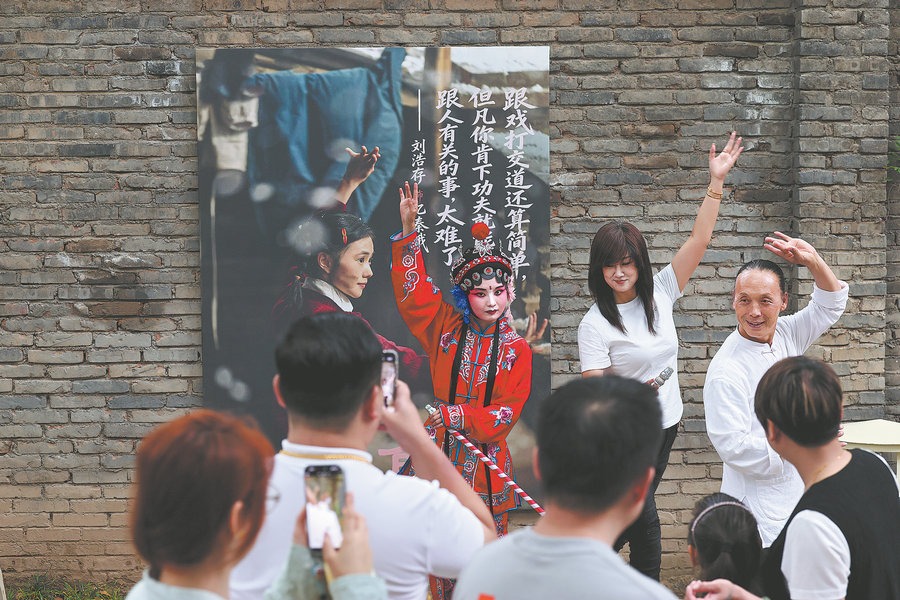
For Qinqiang Opera, which is known for its piercing vocals, rhythmic percussion and emotionally raw storytelling, the sudden mainstream spotlight offers a rare opportunity to reach new audiences, said Li Mei, president of the Shaanxi Opera Research Institute and chief opera consultant for the drama.
"Our theater is now packed for every performance," Li said, adding that promoters from southern cities such as Guangzhou and Shenzhen in Guangdong province and Shanghai have invited them to perform.
Li said that these invited performances have broken the old pattern of Qinqiang Opera only touring the northwest.
She added that, whereas the audience used to be predominantly elderly, it now includes many young people.
However, Li is cautious about the opera's sudden, overwhelming popularity.
"Short-term buzz is hard to sustain," she said. "We need to take advantage of the current attention to refine our productions and encourage repeat visits."
Su Yuanbo, a digital media director at the institute, told China Daily that the institute's touring performances are also selling out across the country.
He said that a performance in Shanghai featuring fire-blowing and other rare techniques had sold out in minutes. After a performance in Beijing, the young audience members who bought tickets because of the TV series said that the live opera was even better than what they saw on television.
"A decade ago, the crowd was mostly older. Today, the proportion of young people has increased significantly," Su said.
For Qinqiang Opera performers, the drama offers a painfully accurate depiction of their own beginnings — a reminder that the road to stardom is long and arduous.
The drama's heroine, Yi Qin'e, spends decades clawing her way from obscurity to stardom — a journey that, according to opera expert Li, defines a true Qinqiang star.
"Ordinary actors care about showing themselves on stage," Li, the institute's president, said. "A true star loves the art from the bottom of her heart."
Countless hardships
Achieving that status means enduring countless hardships, bearing the heaviest burden on stage and suffering what ordinary people cannot imagine offstage.
Chen Li began learning Qinqiang Opera at age 10 and became an actress at the institute six years later. She spent her first decade in the troupe playing nameless extras and palace maids, and nearly quit.
"The opportunities will eventually come to those who are prepared," she recalled her mentor telling her.
Now, 26 years into her career, the 36-year-old performs leading roles.
"Yi Qin'e does not represent any single performer," Chen said. "Her career journey is a shared portrait of every Qinqiang actor."
Fu Xinyao, a performer with 24 years of experience, began her career as a young apprentice — a path that closely mirrors that of the drama's heroine.
"The hardest part is the heavy headgear," she said. "During rehearsals without the full costume, my performance is decent. But once I put on the headpieces, the weight is distracting. It takes years to get used to how the costume affects your acting."
The Shaanxi Opera Research Institute, founded in 1938, has been promoting and preserving Shaanxi operas long before the blockbuster TV drama thrust it into the national spotlight.
The institute has toured the Netherlands, Belgium and dozens of other countries. In 2019, in Paris, France, the troupe performed a stripped-down version of Yang Guifei, a tragic love story about a legendary imperial concubine from the Tang Dynasty (618-907), with no elaborate sets.
"The French audience stood up and applauded for a long time after the show," said Li, the institute head.
She is leading a project to systematically archive more than 20 local opera genres in Shaanxi, preserving scripts, scores, stage recordings and oral histories of veteran artists.
"Theater practitioners need to work like cultural relic restorers — repairing and protecting traditional opera resources," Li said, adding that opera has long served a moral purpose — transmitting loyalty, filial piety and patriotism.
Related Stories



Editor's Pick