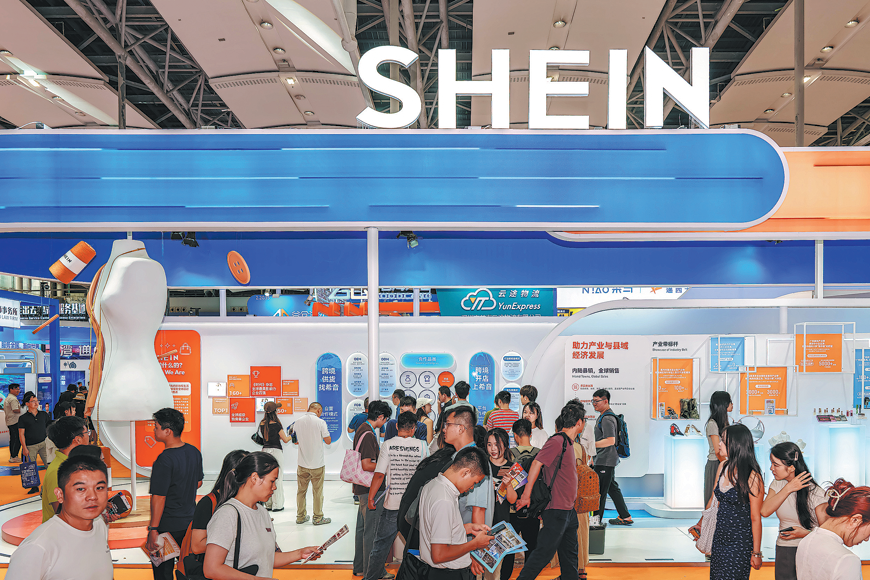
MNCs tap China for global scale
Investing in nation providing strategic buffer, accelerating domestic and overseas growth
By Li Jing | China Daily | Updated: 2026-10-26 08:54


Multinational companies are investing in China to develop technologies for global markets, while Chinese companies are working with foreign partners to turn their innovations into overseas manufacturing and service businesses, executives and economists said.
High-tech industries attracted 228.53 billion yuan ($34.26 billion) in foreign direct investment in the first nine months of 2026, up 33.8 percent year-on-year, according to the Ministry of Commerce. They accounted for 41.6 percent of China's total incoming FDI, up 11.9 percentage points from a year earlier.
FDI in technology commercialization services rose 76.8 percent year-on-year, while investment in research and development and design services increased 59.2 percent, according to the ministry.
Investment in research and development and design services jumped 74 percent, while investment in electronic and telecommunications equipment manufacturing rose 41.9 percent, according to the ministry.
Pan Yuanyuan, a researcher at the Chinese Academy of Social Sciences' Institute of World Economics and Politics, said the value of FDI in China extends beyond capital injections to R&D, technology, sales networks and management expertise. Foreign-invested enterprises have become an important part of China's innovation system, she said.
For Finnish elevator and escalator maker KONE, development work in China is already contributing to its overseas business.
China is KONE's largest single market and hosts its largest R&D center outside Finland. Predictive maintenance solutions for escalators developed in China have already reached overseas markets, said Joe Bao, executive vice-president of KONE and president of KONE Greater China.
"For us, the value of China has never been just about cost," Bao said. "What makes it particularly valuable for KONE is the speed at which we can test, scale and bring new digital service models to local customers and even to the world."
The company opened its South China headquarters earlier this year after increasing investment in the Guangdong-Hong Kong-Macao Greater Bay Area. A cooperation agreement with Guangzhou's Tianhe district aims to apply green and digital technologies to urban renewal, Bao said.
Modernizing existing buildings has created demand for maintenance and equipment upgrades.
Other foreign companies are also extending their operations in China beyond sales, Shanghai Vice-Mayor Lu Shan said at a news conference on Oct 16 ahead of the ninth China International Import Expo, which will run from Nov 5 to 10 in Shanghai.
Lu noted that market responses to new product debuts at the CIIE have bolstered foreign exhibitors' confidence in investing in China and accelerated a growing trend of participants transitioning from "six-day exhibitors" to "long-term investors deeply rooted in China".
Some have moved from trading to manufacturing in China for global markets, while others have established research centers with wider international responsibilities, Lu said.
German drugmaker Bayer plans to move several innovative medicines from packaging in China to manufacturing finished drug formulations locally.
Its Beijing plant is Bayer's largest prescription drug packaging facility worldwide, and is undergoing digital and environmental upgrades, according to the company.
Bayer's research partnerships connect it with Chinese biotech companies and universities. Its Co. Lab incubator in Shanghai brings together 13 Chinese biotech startups, while its E-Town Open Innovation Center in Beijing supports research, clinical translation and industrial cooperation.
The group has conducted more than 110 joint research projects with Tsinghua University and Peking University over the past decade or so, according to the company.
"We will continue to increase investment in China and strengthen our innovation capabilities across research, production and commercialization," said Stefan Oelrich, a member of Bayer's board of management and president of its pharmaceuticals division.
In industrial technology, Chinese teams are also taking on more product development work. Swiss engineering group ABB has invested more than $1.3 billion in China over the past decade, expanding manufacturing and research, said Dong Huijuan, global vice-president of ABB Group.
Speaking at a briefing on international investment trends in Xiamen, Fujian province, in September, Dong said about 85 percent of ABB's sales revenue in China comes from locally manufactured products, systems and services. Chinese teams lead or participate in developing products ranging from electrical equipment to intelligent factory solutions, she said.
Liu Zhaohui, an official with the Shanghai Municipal Commission of Commerce, described a change in research responsibilities at the same event.
"Previously, foreign-funded R&D centers mainly undertook tasks assigned by overseas headquarters. Now, more projects are being conceived and carried out by local teams in Shanghai, which are also participating more deeply in global innovation decisions," Liu said.
Some companies are applying experience gained from upgrading their Shanghai operations to factories elsewhere. They are also reinvesting profits in emerging industries, research and production upgrades, Liu said.
Zhou Mi, a senior researcher at the Chinese Academy of International Trade and Economic Cooperation, said deeper investment in China could help foreign companies cushion external shocks from rising protectionism and geopolitical tensions.
Pan estimated current returns on FDI in China range from about 9 to 10 percent, based on aggregate macroeconomic data. That remains high by international standards, she said, although intensified competition has brought returns below levels seen two or three decades ago.
She underscored the need for drawing on China's institutional strengths to further provide a predictable business environment for foreign investors.
A national action plan issued in June calls for stronger support for foreign-funded R&D centers, improvements in cross-border data flow and revisions to rules on foreign acquisitions of domestic companies. It also requires equal treatment for foreign-invested enterprises in government procurement and bidding.
A separate national tax policy offers eligible overseas investors a credit generally equal to 10 percent of qualifying profits reinvested in China between 2025 and 2028. Conditions include investment in encouraged industries and a holding period of at least five years.
Investment in Chinese technology companies also gives foreign partners new products for their own international operations. For the Chinese businesses, the partnerships can provide a route to customers, suppliers and factories abroad.
Stellantis acquired approximately 21 percent of electric vehicle maker Leapmotor in a deal announced in 2023 at about 1.5 billion euros ($1.68 billion). Their Amsterdam-based venture, Leapmotor International, is owned 51 percent by Stellantis and 49 percent by Leapmotor, with rights to sell and manufacture the Chinese brand's products outside China.
The arrangement combines Leapmotor's electric vehicle technology with Stellantis' established commercial network. By May, the venture had more than 850 sales and service outlets in Europe, following shipments of over 40,000 vehicles to the region in 2025, Stellantis said.
The partners are considering closer manufacturing ties. In May, they outlined proposals for production in Spain and joint purchasing that would combine China's new energy vehicle supplier base with European supply capabilities. A proposed Opel electric SUV could use components sourced through the venture. The initiatives were announced as plans under evaluation.
Suppliers are extending their own partnerships to support that expansion.
Chinese auto parts maker Duoli Technology and Spain's Fagor Ederlan inaugurated their Lieder Automotive plant in Borja, Spain, in September. The facility has 14 production lines, 138 robots and capacity for up to 40,000 chassis a year, according to Fagor.
It is intended to supply structural components for Leapmotor's B10 and B05 electric models for assembly at Stellantis' nearby Figueruelas plant. Fagor said the project had reactivated its Borja facilities and brought more than 170 local jobs.
The partners already operate a venture in Kunshan, Jiangsu province, making aluminum suspension components. Their second joint project gives Duoli its first European manufacturing foothold and Fagor access to Chinese automotive customers expanding in Europe.
China's outward FDI reached $213.58 billion in 2025, up 11.1 percent year-on-year, with accumulated outward investment of about $3.4 trillion, ranking among the world's top three for the ninth consecutive year, according to the annual statistical bulletin on outbound investment released in September.
Chinese companies' overseas businesses employed 4.76 million people at the end of 2025, including 2.97 million non-Chinese employees, the bulletin showed.
For companies building their own overseas plants, serving local customers requires investment beyond factory capacity.
Energy storage company Hithium shipped the first systems from its Mesquite, Texas, plant in August 2025. The facility has a designed annual capacity of 10 gigawatt-hours, the company said.
Wang Pengcheng, Hithium's co-founder and president, said overseas customers increasingly value local delivery, operations and service, making it insufficient simply to ship products from China.
Long-duration storage technology, local operating capabilities and comprehensive international services would together determine companies' competitiveness overseas, he said.
China's overseas expansion comes amid an uneven global investment recovery. Global FDI rose 6 percent to $1.6 trillion in 2025, according to United Nations Trade and Development, with gains concentrated in developed economies.
Li Nan, the UN agency's investment and enterprise director, said Chinese manufacturing investment abroad is continuing to grow as global manufacturing investment weakens, offering developing economies opportunities to join international production networks.
Tighter investment screening and broader national security considerations are increasing uncertainty for companies, she warned, making cooperation between investment policymakers more important.
For host economies, the value of investment depends on the production, employment and skills it supports. Yang Hao, an official with the commerce ministry's department of outward investment and economic cooperation, said Chinese companies are linking overseas projects and technologies with host countries' industrial development plans.
Such cooperation needs to help local economies develop their own capabilities, she said.
For China, Pan said, overseas earnings and technology could support domestic employment, capital formation and tax revenues. Those benefits depend on maintaining links between overseas companies and the businesses that have enabled them to expand, she said.
Wu Huimin, executive dean of the China International Capital Corp Global Institute, said improving overseas performance should be accompanied by better arrangements for capital to flow back to China.
"In the process of overseas expansion, we must pay particular attention to bringing back capabilities from overseas projects, including innovation capabilities and management experience, to avoid industrial hollowing-out and strengthen the domestic industrial foundations of outward investment," Wu said.




Editor's Pick