In search of starry, starry nights
Conservation of night skies' darkness challenges planners, tourism operators
By ZHENG JINRAN | China Daily | Updated: 2026-11-04 07:22


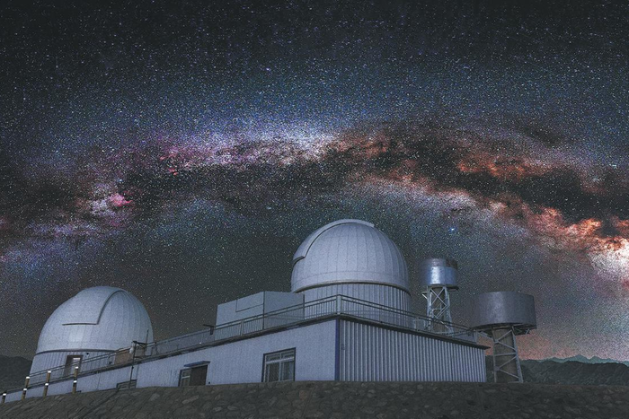
When Ge Yixiao stepped out of her car at Ngari Dark Sky Park, the Milky Way stretched across the night sky above her — a sight she had never witnessed before.
Ge was on a self-driving trip through Southwest China's Xizang autonomous region in August when viewers of her livestream strongly urged her to visit the park in Ngari prefecture. Their enthusiasm convinced her to make the detour.
"The moment I got out of the car, I couldn't stop saying how beautiful it was," she recalled. "I came back again two nights later."
Zhou Zhanglong, a keen stargazer, had visited the park the previous year but missed a clear view of the Milky Way because of bad weather. When he returned this year, he placed stargazing high on his itinerary.
This time, he captured photos of the Milky Way using time-lapse photography on his phone and shared the images with friends.
The two experiences reflect travelers' growing interest in going to places where the stars can still be seen clearly, turning the night sky into a reason to make a journey.
Beyond its value to tourism, however, the natural night sky is essential to astronomical research and wildlife, making dark sky protection an issue of environmental conservation as well as development.
Across China, efforts to preserve this resource are taking different forms, from the remote, high-altitude plateau of Ngari to the astronomical observation hub of Lenghu in Qinghai province and Xichong on the outskirts of Guangdong province's Shenzhen, one of China's largest cities.





Editor's Pick